William Holman Hunt’s The Afterglow in Egypt and the staging of Otherness
Orientalism was an extremely popular genre in literature and art from the late 18th and throughout the 19th century. Like all other genres, it can be broken down into conventions and tropes. But unlike landscapes or still lives, its tropes are fraught with a dark and controversial cultural bias born out of the imperialistic western gaze.1 Since Edward Said paved the way for a critical re-examination of this colonialist depiction of the Other in his seminal book and Linda Nochlin raised our awareness of the sexist and sexualised representation of the female body, we have come to look at orientalist paintings in a different way. Works like Ingres’s Odalique, Delacroix’s Women of Algiers, or Gérôme’s Snake Charmer stand as examples of eroticised images painted to entice western sexual (and imperialist) appetites. In its presumed timelessness, the geographical Other was a counterpart of the historical escapism offered by the re-imagined Middle Ages. These two facets of Otherness come together in two versions of the same subject, The Afterglow in Egypt, painted by William Holman Hunt.
When I took my walks abroad, and looked upon what passed before my eyes, whether of woe or weal, so much was entirely primitive, simple, and withal beautiful, that… I could have no hesitation in being satisfied with the choice for my field of study. In one step I had found escape from the affectations of civilised life. Nature presented itself in its unsophisticated and simple grace, and life reappeared as in its earliest stages.2
After visiting North Africa and the Middle East, the Pre-Raphaelite artist William Holman Hunt (1827-1910) was one of many European intellectuals who became affected by an “Oriental mania”. Even when he returned to Europe, he would continue to wear oriental clothes as a form of exhibited exoticism to show how he had absorbed native customs. His Self-Portrait in the Uffizi Gallery clearly shows that this cultural appropriation was an integral part of his aesthetic statement and self-depiction.3 In January 1854, Hunt left England to join fellow painter Thomas Seddon (1821-1856) in a tour of Egypt and the Holy Land. For two years, the painter travelled across Biblical sites in Egypt, Palestine, and Syria and compiled a visual repertoire for his religious works. Armed with Herodotus, the Bible, John Gardner Wilkinson, and Edward William Lane’s Manners and Customs of the Modern Egyptians (1836), Hunt was interested in capturing “all the traditional manners” that were threatening to disappear rather than contemporary life.4 This hope of finding the remnants of a civilisation lost or frozen in time indelibly shaped Hunt’s approach to the eastern Other.
It must be done by every painter and this most religiously, in fact with something like the spirit of the Apostles, fearing nothing, going amongst robbers and in deserts with impunity as men without anything to lose, and everything must be painted, even the pebbles of the foreground from the place itself, unless on trial this prove impossible.5
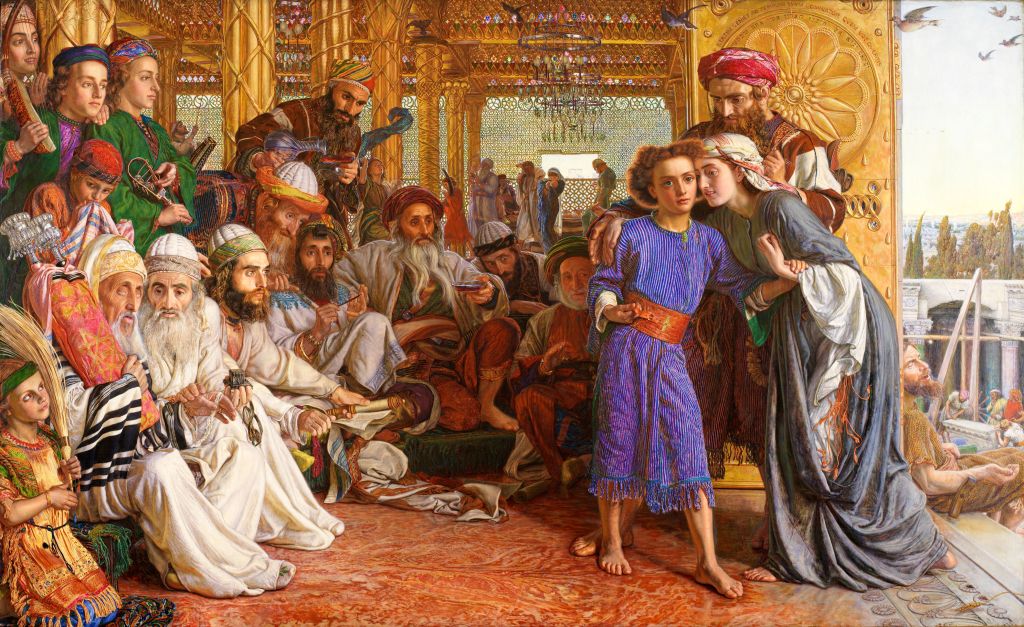
Hunt’s primary concern was to achieve the pictorial truth that was at the heart of the Pre-Raphaelite artistic practice. The study of eastern architectures, landscapes, and above all, people would allow the painter to imbue religious scenes with a sense of phenomenological truth. As Hunt later recalled, what he took away from this first eastern wandering was a larger idea of the principles of design, that is, the local light, colour, and atmosphere.6 Aiming to capture an essence rather than a specific setting, Hunt did not care for exact topographical representation but to achieve a sort of scriptural naturalism. The Finding of the Saviour in the Temple, a painting begun in Jerusalem in 1854, perfectly exemplifies Hunt’s intent which did not go unnoticed by his contemporaries: “By choice and careful study of Oriental figures, dress, and architecture, the outward circumstances have been reproduced, if not with absolute certainty, yet with what is probably by far the nearest approach to fact.”7
Despite his best documentary intentions, Hunt maintained a romanticised notion of these foreign countries as dreamlike places outside of time and space.8 The painter’s antiquarian interest in buildings and landscapes soon gave way to a fascination with exotic figures that conjured fantasies from the “land of good Alraschid” in One Thousand and One Nights.9 Much to his frustration, Hunt however struggled to find female models who were willing to pose forcing him to rework his compositions only after he returned to Europe.10 This delayed elaboration may have also further contributed to the dislocation with his subject: the Orient was a place to be imagined, experienced, and remembered.11
The noise of life was like the ringing bells of a festa, and it was impossible to turn one’s eyes from the open window, where each minute brought forward a new scene, each scene being one of the perennial dramas of the East, heard of, imagined often, but hitherto cut off from me by the intervening leagues of sea.12
Hunt’s ethnographic observations of Egyptian life and customs are recorded in two paintings A Street Scene in Cairo (Birmingham Museum and Art Gallery) and The Afterglow in Egypt (Southampton City Art Gallery) both started in 1854 but completed later in Britain.
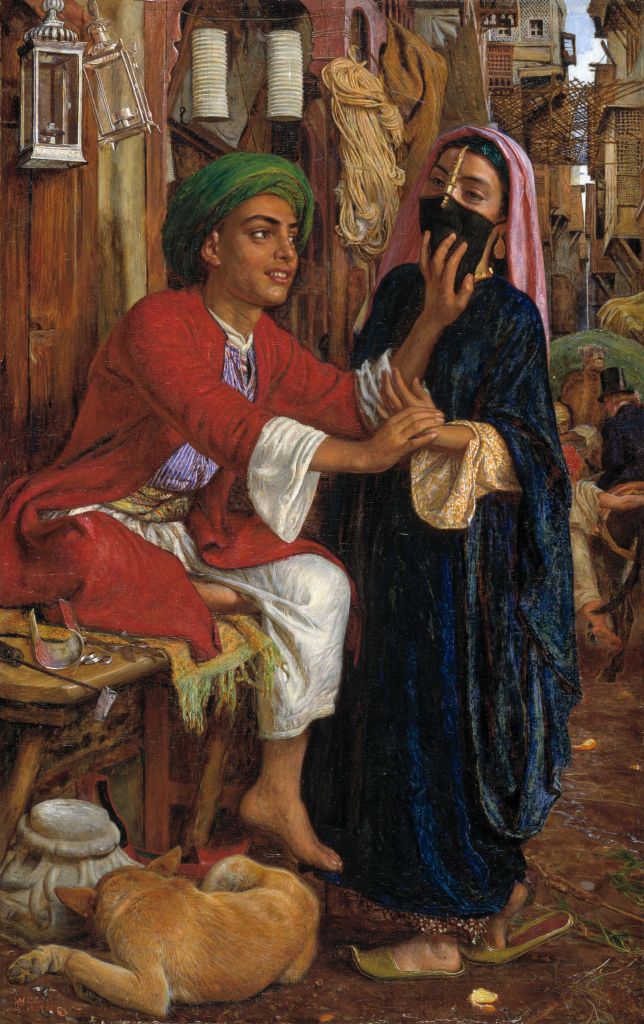
In A Street Scene in Cairo, Hunt intended to capture the unfamiliar sight of women wearing a veil, their appearance preserved to be revealed only to their husband – “I hope it may have some value as an illustration of an unwise state of society which as it appears is fast falling to pieces”.13 Later, Hunt recalled how he stumbled upon the subject, observing the encounter hidden in the dark, and what sense he could make of it:
In an unlit corner I could watch the growth of his natural curiosity, and his pleadings to be allowed to satisfy his eyes as to the features hidden under the black burko. To raise up the veil was an act for which there could be no toleration; to press it close so as to see the outline of the face, the mouth, and the chin, was the utmost that propriety could allow. There was more than a superficial custom in the incident, it symbolised human interest in the unknown, and I decided upon it as a good theme with which to put to the test the possibility of undertaking my first subject picture in the East.14
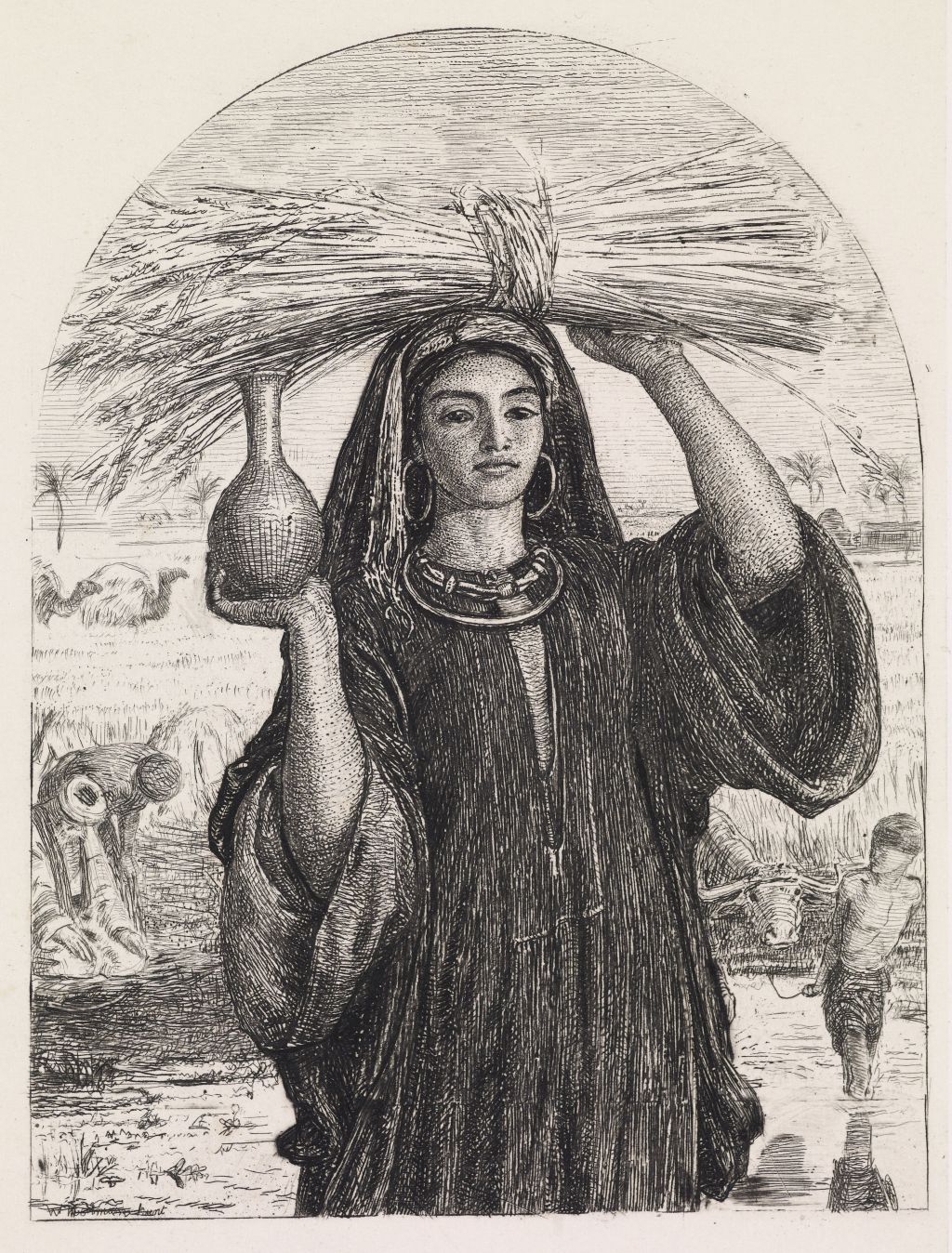
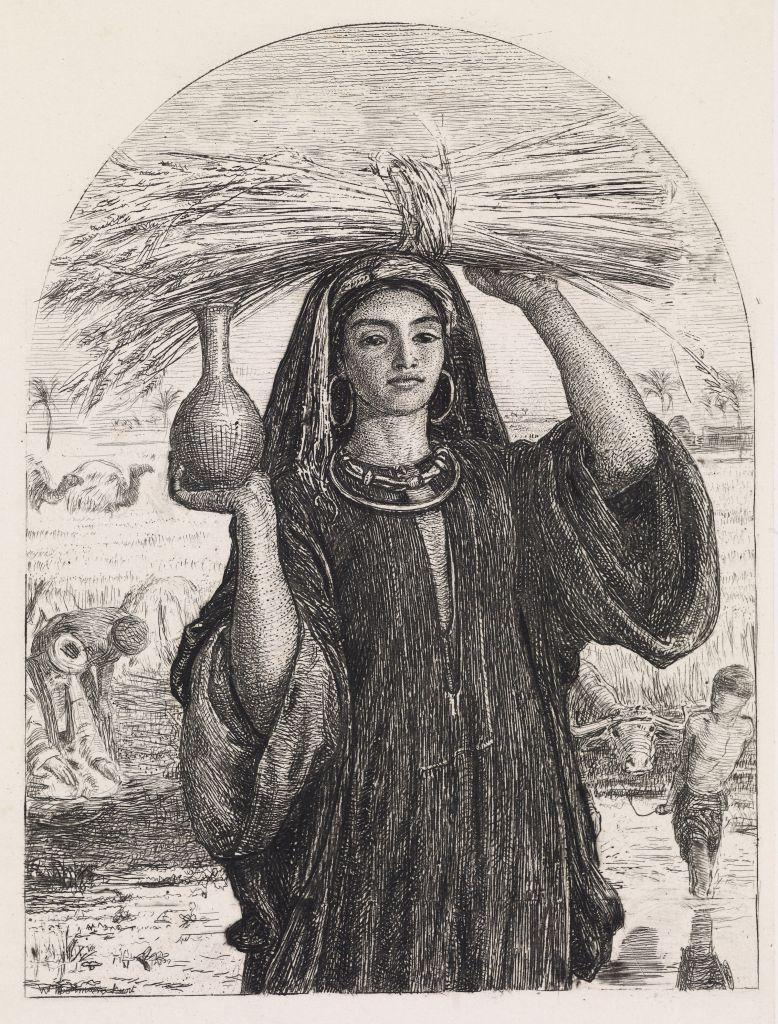
In the countryside, Hunt was surprised to see that peasant women did not cover their faces and was completely beguiled by fellaheen girls – “the most graceful creatures you could see anywhere”. Prowling around the villages he came across a woman and set out to paint a portrait of her in March 1854.15 The inclement weather and the woman’s reluctance to model meant that Hunt was only able to draw a quick sketch. Tirelessly reworking the canvas between 1860 and 1863, Hunt realised a life-size portrait of the woman and called it The Afterglow in Egypt. The towering female figure is depicted barefoot, dressed in traditional clothes, carrying a vase in her right hand and a wheatsheaf over her head. Around her and in the background a plethora of birds is painted in fine detail, on the other side of the river are haystacks, and in the far distance a few palm trees and a camel (the only other exotic reminder). Hunt also painted a smaller version containing a few compositional changes now in the Ashmolean Museum. Gone are the birds replaced by a calf and a boy pulling a cow across the river, and instead of the wheat sheaf the woman is shown carrying a crate with pigeons. Also worth noting is the slight change in her pose and drapery both hinting at classic and renaissance prototypes, a reference that is reflected in the thick linear gilded frame with four embossed roundels reminiscent of Quattrocento altarpieces. For the final version, Hunt interestingly dropped the classicising allusions and opted for a more realistic depiction where the exotic setting is further enhanced by the flamboyant frame with an arched top and pseudo-oriental motifs. Hunt painted the smaller version for a passionate patron and collector of Pre-Raphaelite art, Thomas Combe (1797-1872). While a biographer claimed that the changes were made for the sake of variety, the amendments in the woman’s pose and clothes are not so subtle allusions to the Botticellian models made popular by the Brotherhood.16 Perhaps Hunt made those adjustments to appeal to Combe’s taste or perhaps the exotic subject suggested to him another kind of historical displacement.
Is she the daughter of the Nile? Or is she not rather some goddess of harvest, an Egyptian Ceres? […] This melancholy figure haunts me. […] in these trappings suitable to a slave or a courtesan, I find a symbol of modern Egypt, deposed from the splendour of her ancient civilisation, and fallen from her high, intellectual culture, with nothing left to her but what the fertility of soil, the waters of the Nile and bountiful Nature continue to lavish upon her. […] Steadfast and gloomy, she stands under the weight of the heavy corn; steadfast and lifeless as a block of granite; her life has sunk to an animal, vegetating existence, with perhaps, in the far depths of her soul, a sparkle, a gleam of her former state.17
The Afterglow in Egypt was discussed at length in a popular book by Ernest Chesneau (1833-1890), La Peinture Anglaise, first published in 1882 and translated into English in 1885. The French art critic focused on the mysticism evoked by the word ‘Afterglow’ disclosing views of eastern landscapes bathed in the shadowy twilight. What he was not expecting was the portrait of a woman. Who was she? A goddess of fertility? A courtesan? A slave? An allegorical figure? Chesneau concluded that she symbolised modern Egypt “deposed from the splendour” of a once great civilisation: with nothing left but the fertility of her soil. Hunt, however, rejected the mystical interpretation and clarified that the title meant nothing more than the time of the day which seemed “the most picturesque for the figure of a girl, one of very many now seen in Egypt with a singular resemblance to the old sculpturesque type.”18 The life-size woman dominating the receding landscape and the details carefully arranged like attributes like poppies and pomegranates justified Chesneau’s reading. That he was not completely off the mark was equally suggested by the fact that the very first study of the top half of the woman was indeed titled The Abundance of Egypt. Not to mention that symbolic visualisations were typical of other works inspired by Hunt’s travels to the Holy Land, as can be seen in The Scapegoat.19 The fact that Hunt in a letter to Thomas Combe described Egyptian society as “falling to pieces” compared to its past glories further confirmed Chesneau’s theory, though Hunt may have preferred to shift the focus from its symbolic meaning to its aesthetic value.20
The ideas expressed by Hunt and Chesneau belied prejudiced views that are synonymous with the Orientalist narrative debunked by modern criticism. Literary critic and political activist Edward Said (1935-2003) famously framed the epistemological and ontological notion of Orient in his ground-breaking book Orientalism (1978).21 “One of the deepest and most recurring images of the Other”, the Orient was a construct created by the West to establish its supremacy over “its cultural contestant”. Orientalism was consequently defined as a western style for dominating, restructuring, and exerting control over a culturally inferior Islamic world. This cultural strategy at the service of the colonial agenda was hinged on the juxtaposition between two civilisations, the western ever evolving one, and a supposed eastern other that was the product of unchanging racial and cultural essences. Compared to the West, the Orient was a static, emotional, passive and chaotic entity defined by a series of absences such as the lack of history, movement, meaning, order, etc., and by its availability as an object to be displayed for the dominating European gaze.22 Building on Said’s work, Linda Nochlin (1931-2017) took a closer look at how this phenomenon played out in the visual arts, coming to a similar conclusion:
The orientalist painting depicts a world of timeless customs and rituals, untouched by the historical processes that were drastically altering Western society at the time.23
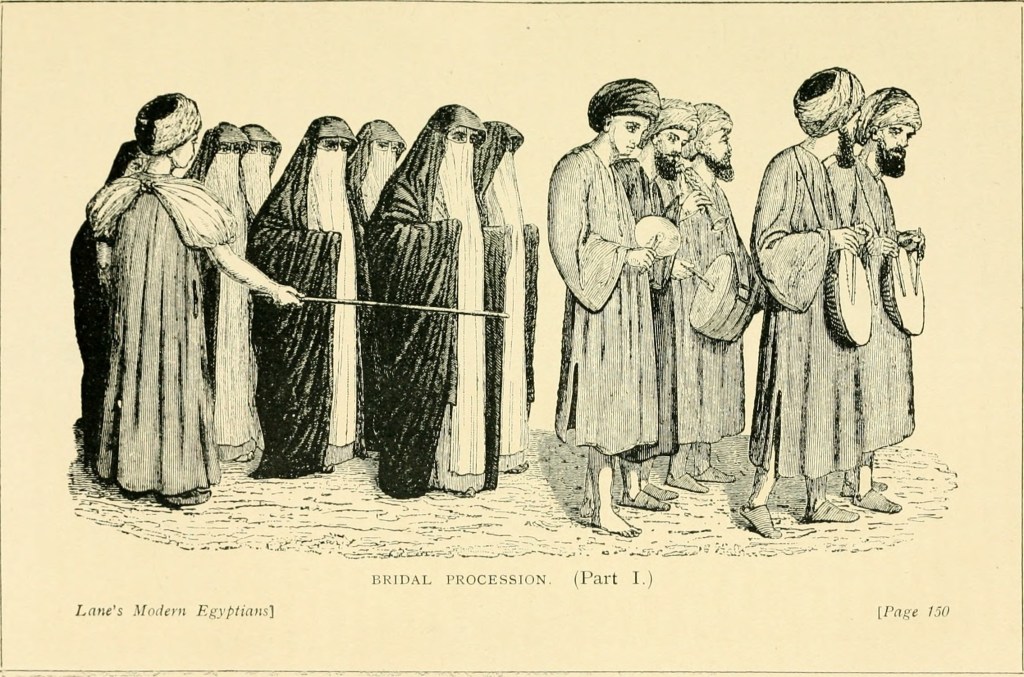
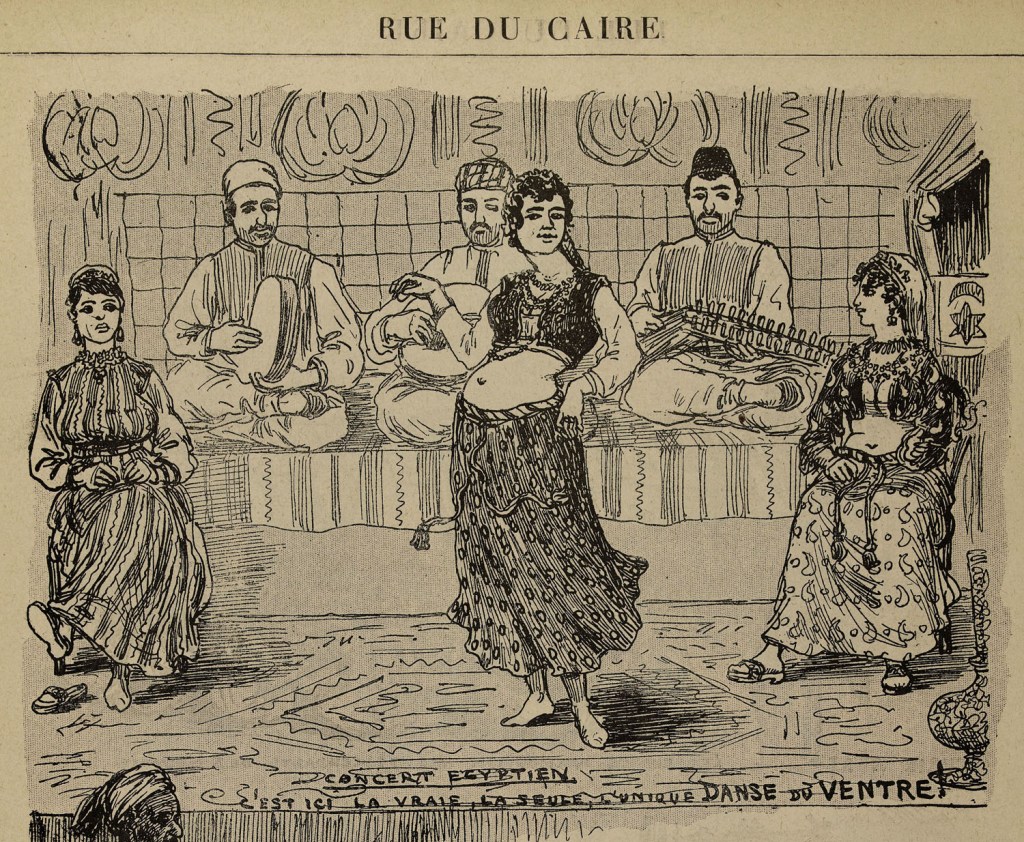
Hunt’s impressions of his eastern wanderings can be read as a self-fulfilling fantasy. Seeking an escape from the “affectations of civilised life”, the painter’s gaze focused on the “primitive”, the “simple” and the “beautiful”, that is, a match for his preconceived idea of a world untouched by history and progress. Over the course of the following decades, the orientalist imagery would be re-enacted and put on display at the World Exhibitions where curious Europeans could see and touch that imagined Other. Monumental and vernacular architectures and chaotic bazaars would be recreated in the Egyptian pavilions at the 1867 Paris Exhibition.24 The bustling streets in Cairo recorded by Hunt would take on a highly spectacularised representation in the Rue du Caire reconstructed on the Champs de Mars for the 1889 Exhibition. Built to resemble the older part of the city, the street was crowded with shops, stalls, and coffee shops where visitors could enjoy a commodified experience of the East complete with donkey rides. Behind the mock façade of a mosque was a coffee house where Egyptian girls danced for the voyeuristic pleasure of the western onlooker, an all too poignant image reinforcing stereotypes.25 Sexualised exoticism was a trope of much of nineteenth-century orientalist art and was heightened by the objectiveness of the licked finish and the plethora of authenticating details. Chesneau’s reference to the fellaheen woman’s “animal and vegetating existence” and the sexually charged interpretation of her profession – a courtesan or a slave – become admissible in the context of the orientalised remoteness. The classicising or allegorising filter in Hunt’s composition – not to mention her being fully clothed – prevented her from being seen an odalisque, though the painter’s obsession with the young model and her resistance to becoming an object on display may reveal a different form of violence.
- For an introduction to Orientalism, see https://www.youtube.com/watch?v=KL-6V2Ymks8 ↩︎
- W.H. Hunt, Pre-Raphaelitism and the Pre-Raphaelite Brotherhood, 2 vols. (London; New York: Macmillan & Co., 1905), I, pp. 376-7. ↩︎
- G.P. Landow, ‘William Holman Hunt’s Oriental Mania and his Uffizi Self-Portrait’, in The Art Bulletin, 64 (1982), 4, pp. 646-55; M. Pointon, ‘The Artist as Ethnographer: Holman Hunt in the Holy Land’, in The Pre-Raphaelites Re-Viewed, ed. by M. Pointon (Manchester: Manchester University Press, 1989), pp. 11-21. ↩︎
- Hunt 1905, I, p. 377. ↩︎
- W.H. Hunt to W.M. Rossetti, 12 August 1855, quoted in Landow 1982, p. 653. ↩︎
- Hunt 1905, II, p. 75: “The object of this [first] journey had not been the transferring of any special scene to canvas, but rather to gain a larger idea of the principles of design in creation which should affect all art.” ↩︎
- T. Palgrave, ‘The Finding of Christ in the Temple, by Mr. Holman Hunt’, in Fraser’s, LXI (1860), p. 644. ↩︎
- Letter to William Bell Scott, 7 April 1870, quoted in Landow 1982, pp. 649-51: “We pass not merely from village to town, and from town to desert, or to an Arab encampment […] but we pass from century to century […]. There are, too, such undreamed-of scenes as though they did not belong to this world but rather to the moon.” ↩︎
- Letter to William Bell Scott, February 1860, quoted in Landow 1982, p. 648. ↩︎
- Letter to John Everett Millais, 16 March 1854, quoted in Hunt 1905, I, p. 381: “I have made the attempt to get women to sit, until at the end of a fortnight or three weeks I have reaped nothing but despair, although I have spared no pains to achieve my purpose.” ↩︎
- Cf. J. Thompson, D. Scott, The East: Imagined, Experienced, Remembered. Orientalist Nineteenth Century Painting (Dublin: National Gallery of Ireland, 1988). ↩︎
- Hunt 1905, I, p. 373. ↩︎
- Letter to Thomas Combe, 26 April 1854, quoted in J.E. Bronkhurst, ‘A Street Scene in Cairo: The Lantern Maker’s’, in The Pre-Raphaelites (London: Tate, 1984), p. 161. ↩︎
- Hunt 1905, I, p. 386. ↩︎
- Letter to John Everett Millais, 16 March 1854, quoted in Hunt 1905, I, p. 382-3: “There are beautiful women here in the country. The fellah girls wear no veils and but very little dress, and these are perhaps the most graceful creatures about twelve or thirteen, when in their prime, you could very well see anywhere. Near the Pyramids, turning a corner, I suddenly came face to face with one of these. The young girl stared like a startled gazelle as though electrified, and suddenly she bounded away with feet almost flying over the earth, making a picture that it was such as should be a perennial joy to any artist.” ↩︎
- A. Clark Amor, William Homan Hunt. The True Pre-Raphaelite (London: Constable, 1989), p. 182. ↩︎
- E. Chesneau, The English School of Painting (London: Cassell, 1885), pp. 192-4; ed. or. La Peinture Anglaise (Paris: Quantin, 1882). ↩︎
- Letter to Ernest Chesneau, 3 December 1882, quoted in G.P. Landow, As Unreserved as a Studio Chat”: Holman Hunt’s Letters to Ernest Chesneau’, in Huntington Library Quarterly, 38 (1975), 4, p. 368. ↩︎
- Cf. G.P. Landow, William Holman Hunt and Typological Symbolism (London: Yale University Press, 1979). ↩︎
- Quoted in J.E. Bronkhurst, ‘The Afterglow in Egypt’, in The Pre-Raphaelites (London: Tate, 1984), p. 163. ↩︎
- E.W. Said, Orientalism (New York: Pantheon Books, 1978). Cf. https://theconversation.com/orientalism-edward-saids-groundbreaking-book-explained-197429 ↩︎
- T. Mitchell, Orientalism and the Exhibitionary Order (1989), in D. Preziosi (ed.), The Art of Art History. A Critical Anthology (Oxford: Oxford University Press, 2009), pp. 409-23: 409. ↩︎
- L. Nochlin, ‘The Imaginary Orient’, in Art in America (May 1983), pp. 119-31, 186-91: 122 [republ. in The Politics of Vision: Essays on 19th Century Art and Society (New York: Harper & Row, 1989), pp. 33-59]. ↩︎
- Cf. Z. Çelik, Displaying the Orient: Architecture of Islam at Nineteenth-Century World’s Fairs (Berkeley: University of California Press, 1992). ↩︎
- Mitchell 1989 [2009], p. 410. ↩︎
 period eye
Leave a comment